Rooms Inside Outside

An interactive exploration of digitally generated liminal spaces that bridges anthropological theory and procedural design.

Liminal spaces (airport terminals, empty parking garages, hotel corridors) exist in a state of perpetual transition. Stripped of their intended function and human presence, these architectural thresholds evoke an uncanny atmosphere of disorientation and potential. Drawing on anthropological concepts of liminality and spatial theory, this project investigates how such transitional environments can be algorithmically generated and experienced as navigable digital spaces.

Rooms Inside Outside begins with a questionnaire that captures the viewer's subjective relationship to liminal aesthetics. These responses seed a procedural generation system that constructs unique architectural environments, each one an algorithmic interpretation of spatial ambiguity and the breakdown of familiar spatial logic.
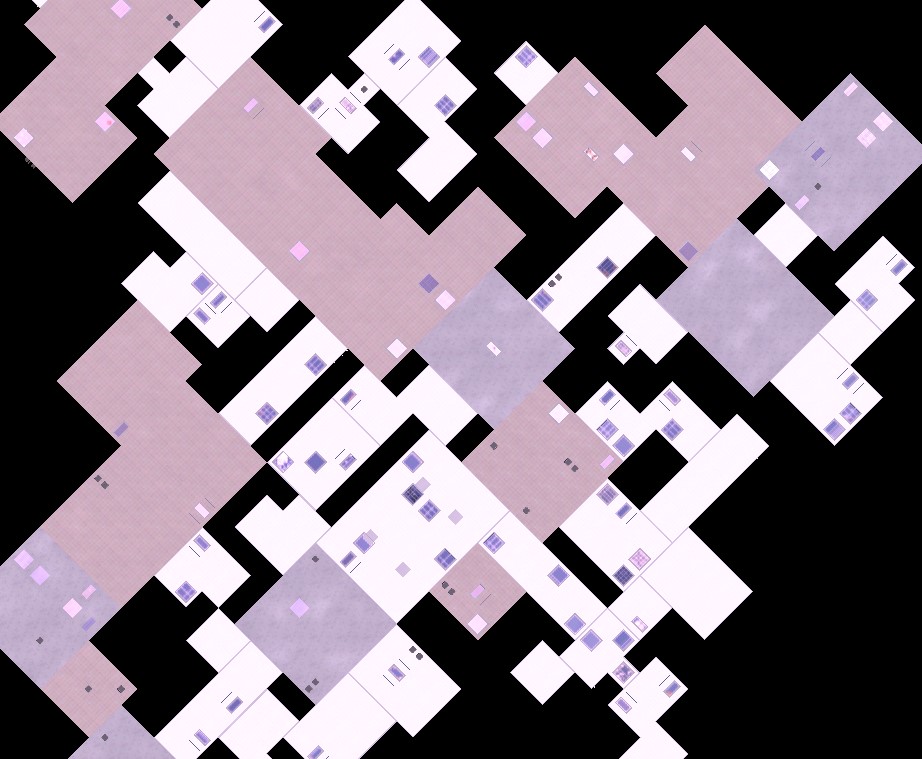
image not found :^(

Unlike most traditional procedural generation which operates invisibly, this project deliberately exposes and slows down the generative process. Viewers witness the space materializing before them, making the algorithm's role as "designer" explicit and transforming generation itself into a performative act. Once constructed, these spaces become navigable, allowing exploration through a first-person perspective reminiscent of video game environments.

The project combines game design, architectural theory, and interactive media to examine how digital spaces can evoke the same unsettling familiarity as their physical counterparts. Virtual environments allow spatial rules to be pushed beyond physical constraints, creating experiences that exist only in the digital realm.

Swarm Behaviour and Environments

An interactive visualization of swarm behaviour simulation exploring similarities between different species.

Developed in the collabortaive project “Re-Shaping Nature - When Scientific Data meets Art and Design” between Merz Akademie and Max Planck Institute of Animal Behavior, this project builds on research by Dr. Daniel S. Calovi and Craig Reynolds' foundational Boids algorithm to create a responsive swarm system. Despite their different habitats, schools of Atlantic mackerel and flocks of starlings operate under remarkably similar behavioral rules. This simulation makes those parallels tangible through direct interaction.

Using a hand tracking sensor, users can influence virtual swarms of mackerel and starlings through hand gestures. The system reads both hands independently to control not just the animals but the environment itself. Placing your left hand in the sensor range summons starlings flying through the sky. Adding your right hand transforms the scene into an underwater environment. Starting with the right hand shows a school of mackerel beneath the surface, and introducing the left hand shifts the scene skyward, creating surreal combinations like mackerel swimming through clouds or starlings navigating underwater currents.

The swarms respond to movement speed and intention. Slow, deliberate gestures attract the creatures toward your hands, drawing them closer as if curious. Quick, sudden movements trigger alarm responses, scattering the swarm in realistic panic dispersal patterns. This interaction model reflects actual animal behavior, where the quality of movement determines whether the swarm approaches or flees.

The installation frames a large screen as a window into these hybrid environments, with the hand tracking sensor positioned in front to capture natural hand movements. The result is an intuitive interface that feels less like controlling a simulation and more like reaching into another world where the boundaries between species and habitat become fluid and negotiable.

Ideal City Number 4 (Spaceship City)

A 3D animated reconstruction of Superstudio's visionary architectural proposal.

Created as a workshop exercise, this project translates Superstudio's Ideal City Number 4 into a navigable digital space. The radical architecture collective's 1970s proposal for a self-contained urban spacecraft is realized here as a fully three-dimensional model floating in space.

The environment allows free-flying navigation around the structure, offering perspectives impossible in the original drawings. By placing the city in a void and enabling unrestricted movement, the piece emphasizes the utopian isolation and architectural ambition of Superstudio's concept. What existed as sketches and conceptual drawings becomes a spatial object that can be examined from any angle, revealing the geometric logic and scale of a reimagined but faithful interpretation of the original vision.

A Dimly Lit Hallway

An interactive representation of time's irreversible passage through an endless corridor.

Dimly Lit Hallway is a first-person experience of walking through an infinite corridor. The space extends forward indefinitely, with procedurally generated elements like doors and plants appearing along the way. None of these objects are interactive, they simply mark your progress through the space.

The defining mechanic is irreversibility. The hallway behind you disappears as you move forward. Turn around and you'll find a wall that wasn't there moments before. There is no going back, only forward. This one-way traversal becomes a direct metaphor for time itself, where each moment erases access to the previous one.

The atmosphere is dark and moody, almost unsettling despite the absence of any actual horror elements. The dim lighting and architectural repetition create an eerie sense of displacement and perpetual motion.

This project serves as a prototype for a larger work currently in development. The core concept and mechanics established here will be expanded and refined, but the fundamental experience of moving through inescapable forward momentum remains central to both versions.

Space and Perception Chamber

A virtual reality experience exploring spatial disorientation and playful gravity interactions through room-scale manipulation.

VR Chamber places you in a derelict office space filled with abandoned technology and decaying design elements from another era. The room appears ordinary except for one detail: the ceiling is flooded with water, creating the illusion that gravity operates in reverse for the upper half of the space.

You hold a remote in your right hand. Two switches on this remote control the fundamental rules of the space. The first flips the entire room 180 degrees. What was ceiling becomes floor, and you find yourself standing underwater. The submersion is crafted for maximum immersion: vision blurs, sounds muffle and distort, particles drift through the water around you.

The second switch toggles gravity itself. Objects begin to float when gravity releases them. But here's where the mechanics reveal themselves: it's the room that rotates, not the world. When you flip the space while gravity is off, the objects don't know the difference. They fall toward what is now the ceiling, obeying a constant gravitational pull that you've simply reoriented through rotation.

The remote serves as your sole point of physical interaction with objects in the space. Without it, you're an observer. With it, you can manipulate the environment, testing how these inverted rules behave when pushed to their limits.

Hi there!
Hi there!
Hi there!
Hi there!
Hi there!
Im Jan-Filip Kvrgic
Glad to have your here :^)
Check out some of my stuff!
(Click on titles to open projects)
Portfolio image